Wednesday, 30 September 2020

'Are people to be left to die?' COVID-19 vaccine pleas fill UN summit

If the United Nations was created from the ashes of World War II, what will be born from the global crisis of COVID-19?

Many world leaders at this week's virtual U.N. summit hope it will be a vaccine made available and affordable to all countries, rich and poor. But with the U.S., China and Russia opting out of a collaborative effort to develop and distribute a vaccine, and some rich nations striking deals with pharmaceutical companies to secure millions of potential doses, the U.N. pleas are plentiful but likely in vain.

See also

"Are people to be left to die?" Honduran President Juan Orlando Hernandez, a COVID-19 survivor, said of the uncertain way forward.

More than 150 countries have joined COVAX, in which richer countries agree to buy into potential vaccines and help finance access for poorer ones. But the absence of Washington, Beijing and Moscow means the response to a health crisis unlike any other in the U.N.'s 75 years is short of truly being global. Instead, the three powers have made vague pledges of sharing any vaccine they develop, likely after helping their own citizens first.

This week's U.N. gathering could serve as a wake-up call, said Gayle Smith, president of the ONE Campaign, a nonprofit fighting preventable disease that's developing scorecards to measure how the world's most powerful nations are contributing to vaccine equity.

"It's not enough for only some G20 countries to realize that an equitable vaccine is the key to ending this virus and reopening the global economy," she said.

With weeks remaining before a deadline for countries to join COVAX, which is co-led by the U.N.'s World Health Organization, many heads of state are using the U.N. meeting as a high-profile chance to wheedle, persuade and even shame.

Ghana's president, Nana Akufo-Addo, pointed out the illusory nature of borders and wealth: "The virus has taught us that we are all at risk, and there is no special protection for the rich or a particular class."

The president of the COVID-free Pacific island nation of Palau, Tommy Remengesau Jr., warned against selfishness: "Vaccine hoarding will harm us all."

And Rwanda's president, Paul Kagame, appealed to the universal desire for a return to normal: "Ensuring equitable access to vaccines, therapeutics and diagnostics will speed up the end of the pandemic for everyone."

Just two days into nearly 200 speeches by world leaders, it was clear the urgent need for a vaccine would be mentioned by almost everyone. Considering the mind-popping challenges ahead, that's no surprise.

"We've never dealt with a situation where 7.8 billion people in the world are needing a vaccine at almost the same time," John Nkengasong, head of the Africa Centers for Disease Control and Prevention, said this month.

That has led to difficult questions: Who will get vaccine doses first? Who is making private deals to get them? This week's speeches make clear that such questions have existential meaning.

The vaccine quest must not be a "purely mercantile act," Iraq said. Nor "an issue of competition," Turkey said.

"We must take the politics out of the vaccine," Kazakhstan said. "We need true globalization of compassion," Slovakia said.

The Dominican Republic deployed all-caps in a statement: "WE DEMAND this vaccine be available to all human beings on the planet." More gently, Mozambique warned that "nationalism and isolationism in the face of a pandemic are, as far as we are concerned, a prescription for failure."

No matter their reputation at home or on the global stage, leaders are finding a shred of common ground as the world nears a staggering 1 million confirmed deaths from the pandemic.

The COVID-19 vaccine must be considered a global public good. Let us be clear on this

Rodrigo Duterte | President of the Philippines

"The COVID-19 vaccine must be considered a global public good. Let us be clear on this," said Rodrigo Duterte, president of the Philippines.

U.N. Secretary-General Antonio Guterres kicked off the General Assembly by declaring in an interview with the U.N.'s media arm: "To think that we can preserve the rich people, and let the poor people suffer, is a stupid mistake."

It's not clear if the world leaders' remarks, delivered not in a diplomatic scrum at U.N. headquarters but in videos recorded from national capitals, will make a difference. Health experts, activists and others anxiously watching the issue raised a collective eyebrow.

"It's important we continue to be making these speeches, but ultimately, speeches alone won't have an effect if there are no real measures put in place to make sure poor countries, and within them the poorest of poor, have access" to the vaccine, said Tendai Mafuma with the South Africa-based social justice group Section 27. It's part of a coalition pressing to make medicines more affordable and accessible.

South Africa, along with many African countries, knows the deadly consequences of having to wait. Health experts say 12 million Africans died during the decade it took for affordable HIV drugs to reach the continent.

Mafuma's countryman Shabir Madhi, lead researcher on a clinical trial in South Africa of the vaccine that Oxford University is developing with pharmaceutical company AstraZeneca, was a bit more optimistic. That most of the world's richest countries have joined COVAX "is promising," he said.

But whether this week's impassioned speeches at the U.N. will make any difference, Madhi said, is still "difficult to tell."


from World,Europe,Asia,India,Pakistan,Philipines,Oceania,Americas,Africa Feed https://ift.tt/36bQ3Jx

India: Engineer arrested for running child pornography racket on Instagram

An engineer who was allegedly running a child pornography racket online since 2019 was arrested by the Central Bureau of Investigation (CBI) in the Indian state of Uttar Pradesh, yesterday.

According to Indian media reports, the accused, identified as Neeraj Yadav, used to make money through online platforms using content that showed sexual abuse of children and child pornography. He would first advertise the content on Instagram and share the inappropriate material with customers through WhatsApp, Telegram, Instagram, and other social media platforms after receiving payment from them.

See more:

The issue came to light when the police got a whiff of the content he was sharing on Instagram. CBI spokesperson RK Gaur told news media outlets: "Allegedly, the accused was advertising on Instagram for the sale of the offensive elements, including child pornographic material.”

The CBI filed a First Information Report and arrested him. They questioned him in detail and found out further information.

The official said: "Yadav also started hosting services and different accounts over cloud storage, using different email IDs."

Read more:

The official added that some more people had come under their scanner based on his testimony.

Later, an investigation team searched his residence in Sonbhadra district of Uttar Pradesh, where they found his mobile phone and sent it for forensic analysis.


from World,Europe,Asia,India,Pakistan,Philipines,Oceania,Americas,Africa Feed https://ift.tt/333nBHU

COVID-19: Worldwide death toll from coronavirus passes 1 million

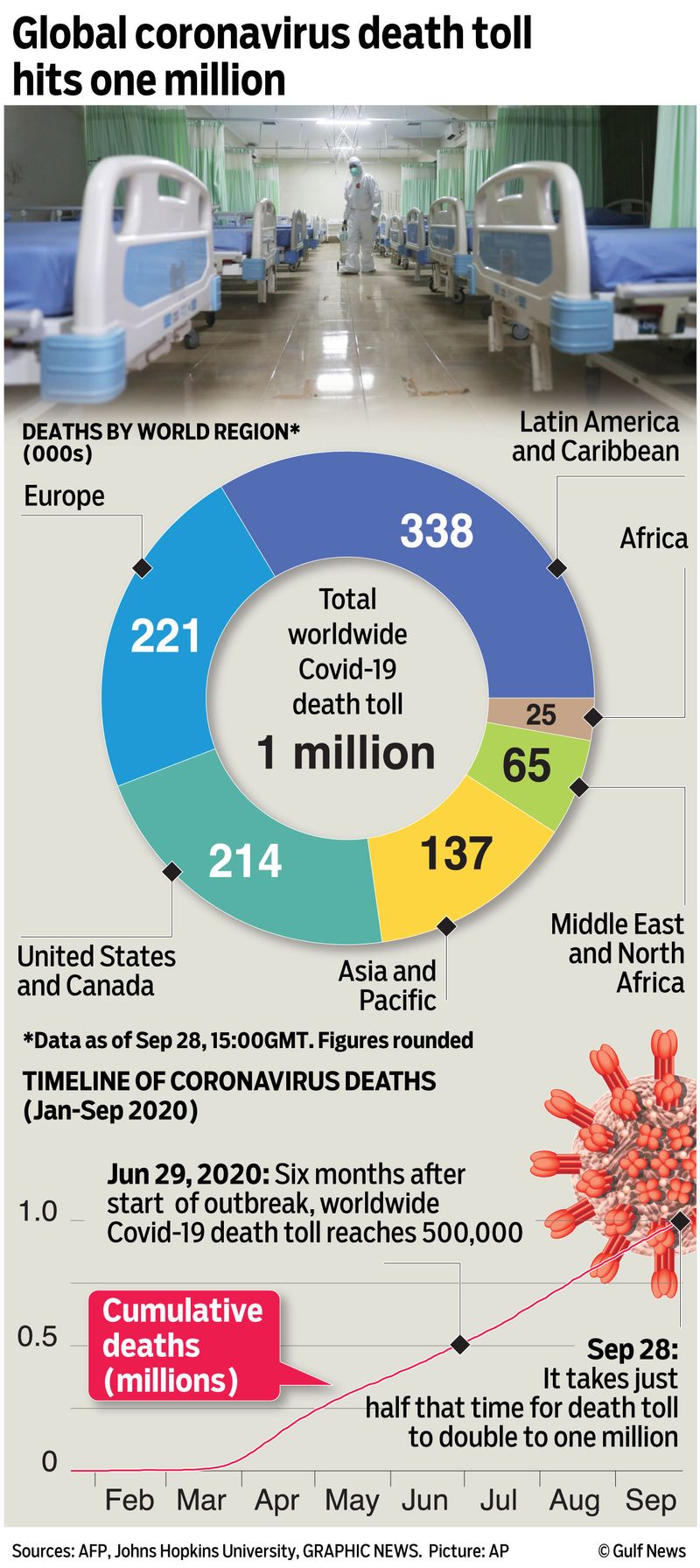
New Delhi: The worldwide death toll from the coronavirus eclipsed 1 million on Tuesday, nine months into a crisis that has devastated the global economy, tested world leaders’ resolve, pitted science against politics and forced multitudes to change the way they live, learn and work.

“It’s not just a number. It’s human beings. It’s people we love,” said Dr. Howard Markel, a professor of medical history at the University of Michigan who has advised government officials on containing pandemics and lost his 84-year-old mother to COVID-19 in February.

See more

“It’s our brothers, our sisters. It’s people we know,” he added. “And if you don’t have that human factor right in your face, it’s very easy to make it abstract.”

The bleak milestone, recorded by Johns Hopkins University, is greater than the population of Occupied Jerusalem or Austin, Texas. It is two-and-a-half times the sea of humanity that was at Woodstock in 1969. It is more than four times the number killed in the 2004 earthquake and tsunami in the Indian Ocean.

Image Credit: Graphic News

Even then, the figure is almost certainly a vast undercount because of inadequate or inconsistent testing and reporting and suspected concealment by some countries. And the number continues to mount. Nearly 5,000 deaths are reported each day on average. Parts of Europe are getting hit by a second wave, and experts fear the same fate may await the U.S., which accounts for about 205,000 deaths, or 1 out of 5 worldwide. That is far more than any other country, despite America’s wealth and medical resources.

“I can understand why ... numbers are losing their power to shock, but I still think it’s really important that we understand how big these numbers really are,” said Mark Honigsbaum, author of “The Pandemic Century: One Hundred Years of Panic, Hysteria and Hubris.”

The global toll includes people like Joginder Chaudhary, who was his parents’ greatest pride, raised with the little they earned farming a half-acre plot in central India to become the first doctor from their village. After the virus killed the 27-year-old Chaudhary in late July, his mother wept inconsolably. With her son gone, Premlata Chaudhary said, how could she go on living? Three weeks later, on August 18, the virus took her life, too. All told, it has killed more than 95,000 in India.

“This pandemic has ruined my family,” said the young doctor’s father, Rajendra Chaudhary. “All our aspirations, our dreams, everything is finished.”

First death in Wuhan 

When the virus overwhelmed cemeteries in the Italian province of Bergamo last spring, the Rev. Mario Carminati opened his church to the dead, lining up 80 coffins in the center aisle. After an army convoy carted them to a crematory, another 80 arrived. Then 80 more. Eventually the crisis receded and the world’s attention moved on. But the pandemic’s grasp endures. In August, Carminati buried his 34-year-old nephew. “This thing should make us all reflect. The problem is that we think we’re all immortal,” the priest said.

The virus first appeared in late 2019 in patients hospitalized in the Chinese city of Wuhan, where the first death was reported on January 11. By the time authorities locked down the city nearly two weeks later, millions of travelers had come and gone. China’s government has come in for criticism that it did not do enough to alert other countries to the threat.

Government leaders in countries like Germany, South Korea and New Zealand worked effectively to contain it. Others, like US President Donald Trump and Brazil’s Jair Bolsonaro, dismissed the severity of the threat and the guidance of scientists, even as hospitals filled with gravely ill patients.

Brazil has recorded the second most deaths after the US, with about 142,000. India is third and Mexico fourth, with more than 76,000.

The virus has forced trade-offs between safety and economic well-being. The choices made have left millions of people vulnerable, especially the poor, minorities and the elderly.

With so many of the deaths beyond view in hospital wards and clustered on society’s margins, the milestone recalls the grim pronouncement often attributed to Soviet dictator Josef Stalin: One death is a tragedy, millions of deaths are a statistic.

The pandemic’s toll of 1 million dead in such a limited time rivals some of the gravest threats to public health, past and present. It exceeds annual deaths from AIDS, which last year killed about 690,000 people worldwide. The virus’s toll is approaching the 1.5 million global deaths each year from tuberculosis, which regularly kills more people than any other infectious disease.

But “COVID’s grip on humanity is incomparably greater than the grip of other causes of death,” said Lawrence Gostin, a professor of global health law at Georgetown University. He noted the unemployment, poverty and despair caused by the pandemic, and deaths from myriad other illnesses that have gone untreated. For all its lethality, the virus has claimed far fewer lives than the so-called Spanish flu, which killed an estimated 40 million to 50 million worldwide in two years, just over a century ago.

That pandemic came before scientists had microscopes powerful enough to identify the enemy or antibiotics that could treat the bacterial pneumonia that killed most of the victims. It also ran a far different course. In the U.S., for example, the Spanish flu killed about 675,000. But most of those deaths did not come until a second wave hit over the winter of 1918-19.

Up to now, the disease has left only a faint footprint on Africa, well shy of early modeling that predicted thousands more deaths.

But cases have recently surged in countries like Britain, Spain, Russia and Israel. In the United States, the return of students to college campuses has sparked new outbreaks. With approval and distribution of a vaccine still probably months away and winter approaching in the Northern Hemisphere, the toll will continue to climb.

“We’re only at the beginning of this. We’re going to see many more weeks ahead of this pandemic than we’ve had behind us,” Gostin said.


from World,Europe,Asia,India,Pakistan,Philipines,Oceania,Americas,Africa Feed https://ift.tt/3if26rX

Uptick: New York logs more than 1,000 daily COVID-19 cases

Albany, New York: More than 1,000 New Yorkers tested positive for COVID-19 in a single day, marking the first time since June 5 the state has seen a daily number that high.

The number of positive tests reported daily in the state has been steadily inching up in recent weeks, a trend possibly related to increasing numbers of businesses reopening, college campuses reopening and children returning to school. Gov. Andrew Cuomo announced Saturday there were 1,005 positive cases tallied on the previous day, Friday, out of 99,953 tests, for a 1% positive rate.

see more

From late July through the start of September the state was seeing an average of around 660 people test positive per day. In the seven-day period that ended Friday, the state had averaged 817 positive tests per day.

Cuomo aide Gareth Rhodes stressed Saturday that the new positive-case number came out of nearly 100,000 tests, compared to about 60,000 tests daily in June.

"Is there cause for concern? As long as COVID is here, yes,'' Rhodes posted on Twitter, noting that certain ZIP codes in Brooklyn and the lower Hudson Valley have seen increases in new cases and hospital admissions. "Key is ensuring these clusters don't spread into neighboring/other ZIPs.''

Rhodes also noted improving numbers among college-aged people, suggesting better compliance on campuses.

That number of daily positive tests in a state of more than 19 million people still puts New York in a much better position than many other states. Florida, for instance, reported 2,795 new confirmed cases of COVID-19.

And New York is in a far better situation than in April, when the number of positive tests per day routinely topped 9,000, even though tests then were hard to get and people were being encouraged not to seek one unless they were gravely ill.

Still, the uptick has been a cause for concern. In New York City, health officials have sounded alarms about a rising number of cases in certain neighborhoods in Brooklyn and Queens where many private religious schools opened for in-person instruction in early September, warning that those communities could see severe restrictions on public gatherings reinstated if current trends continue.

Public school students in New York City's elementary, middle and high schools are set to resume in-person instruction next week Sept. 29 and Oct. 1.

On Friday night, New York City deputy sheriffs broke up an illicit wedding celebration at a hall in Queens after receiving an anonymous complaint about social distancing violations, WNBC-TV reported. The deputies discovered 284 guests attending the event, which included seating, food, alcohol and a live band.


from World,Europe,Asia,India,Pakistan,Philipines,Oceania,Americas,Africa Feed https://ift.tt/340I9Qt

India: Teenage girl battles for life in ICU after 4 men gang-rape in Uttar Pradesh

Recently, the incident of alleged gang rape of a 19-year-old girl by four upper-caste men has come to light in Hathras district from the Indian state of Uttar Pradesh. The woman belonged to a Dalit community (Dalit is a caste defined in the Indian Constitution under Article 341, listed as the Scheduled Castes). The accused also attempted to murder the woman by strangling her, which left her battling for her life at Aligarh Medical College hospital's Intensive Care Unit (ICU) for several days, reportedly.

The victim's condition is said to be stable now, but she is still being administered care in the ICU. Subsequently, police have recorded her statement on Tuesday. She stated that the accused sexually assaulted her on September 14 when she went to gather fodder for cattle.

See more:

Based on the complaint lodged by the victim's brother, police had earlier registered a case against a man, who was later identified as Sandeep, for an attempt to murder and under sections of the Scheduled Caste/ Scheduled Tribe (SC/ST) Act according to the Indian Penal Code. However, after recording her statement on Tuesday, police added charges of gang-rape to the First Information Report.

Confirming the incident, Hathras district superintendent of police, Vikrant Veer said: "Another accused has been caught, and others will be arrested soon."

Read more:

According to the Indian news reports, police have arrested two of the four accused, and efforts are on to arrest others.


from World,Europe,Asia,India,Pakistan,Philipines,Oceania,Americas,Africa Feed https://ift.tt/3iby0pq

European police bust cross-Channel migrant smuggling ring

The Hague: European police have busted a human smuggling ring said to be part of a network transporting thousands of migrants in life-threatening conditions across the Channel to Britain.

Law officers, working together with Europe’s policing and judicial agencies Europol and Eurojust arrested 12 suspected smugglers over the last two days, the Hague-based Eurojust said in a statement on Wednesday.

See more

“Twelve suspects were arrested in the combined operation including seven in France, three in Britain and two in the Netherlands,” it said. Police also seized 12 vehicles, 10 rubber boats and engines, 152 life jackets, a caravan, a boat trailer, jewellery, about 48,000 euros ($56,000) in cash, documents and mobile devices, Eurojust said.

Those arrested are suspected of being part of a mainly Iranian organised smuggling gang based in France, the Netherlands and Britain, organising their activities through their ties in the various countries. “The network is believed to have made huge profits from smuggling migrants in small boats from the north coasts of France to Britain,” charging an average of 3,000 euros per crossing, Eurojust said.

Exponential increase

“Transporting migrants in overloaded boats, often in very difficult weather conditions on one of the busiest commercial shipping lanes in the world, endangered the lives of both the migrants and also the law enforcement officers conducting sea rescue operations,” it said.

Eurojust said illegal migrant-smuggling activity has “increased exponentially” in recent months with over 4600 irregular migrants detected since 2018 on British shores. The combined operation comes as French police on Tuesday dismantled a camp of about 800 migrants in the port city of Calais.

Calais continues to attract migrants from the Middle East and Africa who set up makeshift camps along France’s northern coast from where they hope to make the passage across the English Channel to Britain.

Since January 1, French authorities have intercepted at least 1,317 migrants as they tried to reach the UK, some by swimming across the busy waterway.

In August, a Sudanese teenager drowned while trying to reach Britain with a friend in an inflatable boat.


from World,Europe,Asia,India,Pakistan,Philipines,Oceania,Americas,Africa Feed https://ift.tt/3ifY6ri

COVID-19: Moderna vaccine appears safe, works in older adults

Chicago: Results from an early safety study of Moderna Inc’s coronavirus vaccine candidate in older adults showed that it produced virus-neutralizing antibodies at levels similar to those seen in younger adults, with side effects roughly on par with high-dose flu shots, researchers said on Tuesday.

The study, published in the New England Journal of Medicine, offers a more complete picture of the vaccine’s safety in older adults, a group at increased risk of severe complications from COVID-19.

See more

The findings are reassuring because immunity tends to weaken with age, Dr. Evan Anderson, one of the study’s lead researchers from Emory University in Atlanta, said in a phone interview.

The study was an extension of Moderna’s Phase I safety trial, first conducted in individuals aged 18-55. It tested two doses of Moderna’s vaccine - 25 micrograms and 100 micrograms - in 40 adults aged 56 to 70 and 71 and older.

Overall, the team found that in older adults who received two injections of the 100 microgram dose 28 days apart, the vaccine produced immune responses roughly in line with those seen in younger adults.

Moderna is already testing the higher dose in a large Phase III trial, the final stage before seeking emergency authorization or approval.

Side effects, which included headache, fatigue, body aches, chills and injection site pain, were deemed mainly mild to moderate.

In at least two cases, however, volunteers had severe reactions.

One developed a grade three fever, which is classified as 102.2 degrees Fahrenheit (39C) or above, after receiving the lower vaccine dose. Another developed fatigue so severe it temporarily prevented daily activities, Anderson said.

Typically, side effects occurred soon after receiving the vaccine and resolved quickly, he said.

“This is similar to what a lot of older adults are going to experience with the high dose influenza vaccine,” Anderson said.

“They might feel off or have a fever.” Norman Hulme, a 65-year-old senior multimedia developer at Emory who took the lower dose of the vaccine, said he felt compelled to take part in the trial after watching first responders in New York and Washington State fight the virus.

“I really had no side effects at all,” said Hulme, who grew up in the New York area.

Hulme said he was aware Moderna’s vaccine employed a new technology, and that there might be a risk in taking it, but said, “somebody had to do it.”


from World,Europe,Asia,India,Pakistan,Philipines,Oceania,Americas,Africa Feed https://ift.tt/2Gdx1bb

testhjg